


1
1
MANUFACTURING PROCESS
![]() Qingdao Port Opens Dedicated Green Hub for Galvanized Steel, Cutting Export Clearance Time 40%
Qingdao Port Opens Dedicated Green Hub for Galvanized Steel, Cutting Export Clearance Time 40%On August 16, 2026, Qingdao Port in Shandong officially put into operation the country’s first dedicated intelligent warehousing and consolidation center for galvanized steel sheets and coils. Based on the information provided, the development is notable not only as a logistics upgrade but also as an execution signal around export handling, origin verification, cargo inspection, and environmental monitoring. For galvanized steel exporters, supply chain service providers, buyers, and compliance teams, the main point of attention is how faster customs and vessel-loading processes may increasingly depend on more standardized documentation, traceability, and on-site verification capabilities.
What Has Been Confirmed at the New Facility
According to the provided event summary, the facility was officially launched on August 16, 2026, at Qingdao Port. It is described as the first dedicated intelligent storage and consolidation center in China for galvanized steel sheets and coils. The center integrates automatic coding, non-destructive bundling inspection, online VOCs monitoring, and an AI-based RCEP origin verification system. The same summary states that the facility has shortened the shipping cycle for galvanized cargo, reducing the average combined export customs clearance and vessel-loading time from 5.2 days to 3.1 days. The information provided further indicates that this benefits delivery stability for galvanized steel exporters in Shandong and nearby areas.
Where the Practical Effects May Appear First
For galvanized steel exporters managing shipment schedules
Analysis suggests that the most immediate effect may be on export execution rather than on product standards themselves. Exporters handling galvanized sheets and coils may see greater value in aligning cargo preparation, origin documentation, and shipment timing more closely with port-side verification systems. What deserves closer attention is whether faster turnaround increasingly favors companies that can present cleaner, more consistent export files and traceable cargo identification from the start.
For logistics and consolidation service providers
From an industry perspective, supply chain service providers may be affected in the cargo handover, warehousing, inspection coordination, and vessel booking stages. Because the new center combines automatic coding, bundling inspection, VOCs monitoring, and AI-assisted origin review, service providers may need to pay closer attention to data consistency across packing details, cargo marks, handling records, and supporting trade documents. This is an analytical judgment based on the facility design described in the input, not a confirmed new mandatory rule.
For buyers and procurement teams watching delivery reliability
For procurement teams sourcing galvanized steel products, the development may matter less as a policy headline and more as a delivery-control signal. The stated reduction in clearance and loading time suggests a possible improvement in schedule predictability for export shipments routed through this channel. At this stage, buyers may need to monitor whether suppliers using the new facility can provide more stable dispatch windows, clearer traceability, and better document readiness for trade execution.
For compliance, testing, and origin-document workflows
The inclusion of non-destructive bundling inspection, VOCs online monitoring, and AI-based RCEP origin verification suggests that compliance-related checks are becoming more embedded in the logistics process itself. Analysis suggests that companies involved in certification, inspection support, document preparation, or trade compliance should watch whether operational expectations rise around cargo integrity records, environmental monitoring visibility, and origin-related supporting materials. The provided information does not confirm any new formal certification requirement, so this should be treated as an execution trend worth monitoring rather than a definitive regulatory change.
Points Companies Should Review Now
Check origin-related document readiness
Because the facility includes an AI-based RCEP origin verification system, exporters should review whether their origin declarations and supporting records are internally consistent before cargo reaches the port. The current information does not specify any revised filing rule, but it does suggest that origin-related checks may become more operationally visible in the shipment process.
Reassess cargo marking and traceability controls
Automatic coding and dedicated handling for galvanized sheets and coils indicate that cargo identification may become more tightly linked to processing speed. Companies should therefore verify whether internal labeling, batch tracking, and shipment data can match the level of traceability expected in a smart consolidation environment. This is a precautionary operational review, not a confirmed mandatory adjustment.
Review packaging and bundling quality records
The reference to non-destructive bundling inspection means exporters and processors should pay attention to whether bundling quality records, packaging specifications, and handover conditions are complete enough to avoid delays or disputes during port-side checks. If shipments are expected to move faster, documentation gaps may become more visible rather than less important.
Adjust delivery planning with caution
The reduction from 5.2 days to 3.1 days in average export clearance plus loading time is a concrete operating signal from the provided summary. Even so, companies should avoid treating that figure as a universal lead-time guarantee. A more prudent approach is to reassess booking windows, inventory buffers, and customer delivery commitments while continuing to verify how consistently the new process performs in actual trade execution.
Why This Looks More Like an Execution Signal Than a New Rule Text
At this stage, it is more appropriate to understand the launch of the dedicated galvanized steel hub as a practical implementation signal around trade facilitation, digital verification, and cargo compliance integration. The provided information does not identify a new regulation number, formal policy text, or revised standard clause. What it does show is that port-side infrastructure is being configured to combine customs efficiency, origin review, inspection support, and environmental monitoring in one operating chain. For the industry, the key question is not whether a new legal obligation has already been announced in the input, but whether similar execution expectations will gradually shape document quality, delivery planning, and supplier selection.
How the Industry May Best Interpret This Development
Based on the confirmed facts available here, the launch of the Qingdao Port facility should be read as an already implemented operational change with possible implications for export compliance and delivery management in galvanized steel trade. It is not, on the information provided, a standalone new regulation. A neutral reading is that companies involved in galvanized steel exports should treat it as a sign that efficiency gains may increasingly be tied to traceability, origin verification readiness, inspection coordination, and standardized cargo handling. The commercial impact may become clearer only after more market-side execution feedback appears.
Basis of This Article and What Still Needs Verification
This article is based solely on the user-provided news title, event date, and event summary. For developments of this type, relevant source categories would typically include official announcements, regulator releases, customs or trade authority information, industry association updates, standard-setting documents, and reporting by authoritative media. No specific official source link was provided in the input, so the exact official reference path still needs to be verified. Follow-up attention should remain on any later policy detail, certification interpretation, tender-document changes, trade execution outcomes, and industry feedback related to the facility’s actual use.
More Content![]() CT150Q High-Strength Continuous Pipe Rolls Out, Signaling a Shift in China’s Galvanized Pipe Compliance
CT150Q High-Strength Continuous Pipe Rolls Out, Signaling a Shift in China’s Galvanized Pipe ComplianceIn August 2026, a domestic production line for CT150Q-class large-diameter quenched-and-tempered continuous pipe was put into operation, and the product has already passed API RP 5C5 certification. Because the pipe combines ultra-high strength with corrosion resistance through specialized heat treatment and a galvanized composite process, the development is relevant not only to oil and gas users, but also to projects and procurement teams in photovoltaic mounting structures and offshore wind applications. For the industry, the key issue is not the product launch itself, but the signal it sends about how performance standards, certification expectations, and engineering procurement choices are moving upward together.
What Has Been Confirmed About the Product and Certification Path
The information provided confirms that, in August 2026, China’s first production line capable of producing CT150Q-grade large-diameter quenched-and-tempered continuous pipe was commissioned. The product is described as having a yield strength of at least 1500 MPa and as using a special heat-treatment process combined with galvanizing to improve corrosion resistance. It has passed API RP 5C5 certification. The stated application areas are oil and gas, photovoltaic support structures, and offshore wind.
Where the Compliance Impact Is Likely to Land
Procurement teams will need tighter technical alignment
Analysis suggests that buyers in oil and gas, renewable-energy structures, and related engineering projects may need to treat strength class, corrosion performance, and certification status as linked procurement items rather than separate checks. That affects tender documents, supplier prequalification, and delivery acceptance, especially where the buyer needs proof that the product matches the service environment and technical specification.
Manufacturers may face a higher bar on traceability
For processing and fabrication enterprises, the main impact is likely to appear in quality documentation, heat-treatment records, coating or galvanizing records, and product traceability. Where API RP 5C5 is referenced in contracts or downstream specifications, suppliers may need to keep their test and conformity files more organized to avoid delays during customer review or third-party verification.
Engineering contractors will pay more attention to specification matching
From an industry perspective, this type of product is more likely to be adopted where project owners are asking for engineered solutions instead of standard pipe stock. That means contractors and system integrators may need to re-check whether the pipe’s certified performance is sufficient for the working conditions, rather than relying on category labels alone. The practical issue is specification alignment, not marketing value.
Trade and distribution channels may see stricter document review
For distributors and trade intermediaries, the likely change is a more document-heavy sales process. When a product is positioned as a certified high-performance material, customers often expect cleaner paper trails, clearer product grades, and faster proof of compliance. That can lengthen quotation and fulfillment cycles if supporting documents are incomplete.
What Enterprises Should Check Before Treating This as Ready-to-Use Supply
Verify the scope of certification, not only the certification name
At this stage, it is more appropriate to understand this as a clear market signal rather than a universal rule change. Enterprises should confirm what exactly the API RP 5C5 certification covers for the product, how it maps to their own technical requirements, and whether any additional customer-side testing is still needed before purchase or installation.
Review bid files and technical documents for updated acceptance terms
Where future projects mention high-strength continuous pipe, galvanized pipe, or corrosion-resistant structural materials, the bid documents may begin to place more weight on certification evidence, heat-treatment documentation, and service-condition suitability. Buyers should review whether existing templates still capture those points clearly enough.
Stress-test substitution plans before changing supply chains
If a project is considering replacing conventional galvanized pipe with this higher-spec product, the substitution should be checked against load, corrosion, and installation requirements. The available information supports attention to technical validation, but it does not justify assuming automatic interchangeability.
Keep an eye on downstream acceptance practice
What matters next is how purchasers, inspectors, and project owners actually apply the standard in day-to-day acceptance. The present information confirms a production and certification milestone; it does not confirm how broadly the product will be accepted across all project types or procurement systems.
How to Read the Market Signal at This Stage
This development is best read as an execution signal. It shows that the market for galvanized steel pipe is moving beyond standard-size supply toward engineering-grade products with defined performance and certification expectations. That does not mean every related market will change at the same speed, but it does mean compliance, certification, and specification language are becoming more central to commercial decisions.
For industry participants, the useful question is not whether the headline product is advanced, but whether their own procurement, testing, and delivery processes are ready for a higher-compliance product category. The next round of useful information will come from buyer adoption, tender language, acceptance practice, and any further clarification of certification scope.
What This Means for the Sector Going Forward
Overall, the information points to a practical shift in how high-end galvanized pipe is being positioned in the market: as a certified engineering material rather than a general-purpose commodity. The immediate takeaway is cautious but concrete. Enterprises should treat this as a sign to tighten technical review, document control, and supplier verification, while continuing to observe how the certification and acceptance practices are applied in real projects.
Source Basis and What Still Needs Verification
This article is based solely on the user-provided title, event timing, and summary. No specific official source link was provided in the input. For this type of development, the relevant source categories would normally include official company disclosures, certification bodies, industry association notices, standard-related documents, and authoritative trade or media reporting. The items that still need continued verification are the detailed certification scope, any project-side acceptance rules, tender file updates, and actual downstream market adoption.
More Content Hot Rolled Steel
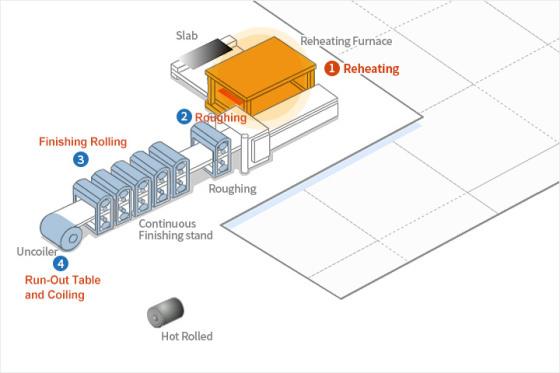
1. Reheating: Hot rolled coils pass through a pickling line, where scale breaker machines and hydrochloric acid solutions are used to remove any surface scale and/or oxide film that which causes surface flaws during the final stage of cold rolled steel processing.
2. Roughing: In this process, slabs whose surface scale share has been removed are made into rolled materials with the proper shape, thickness, and width. In the entry and exit area of the roughing mill, an edger rolls the strip in the width direction using an Automatic Width Control (AWC) system.
3. Finishing Rolling: The purpose of finishing rolling is to adjust the thickness and width of a coil to the specified dimensions and to produce a smooth surface and shape at the desired finishing temperature appropriate for its intended use. Our up-to-date equipment, including Work Roll Shift Mills, Pair Cross Mills and On-line Roll Grinders (ORG), enhances plant productivity and improves the quality of the finished coils by controlling the crown shape.
4. Run-Out Table and Coiling: Steel strips, after the finishing mill, are passed to the run-out table where they are coiled. While being rolled on the table, the strips are sprayed with water to cool them to the proper temperature for coiling.
More Content Galvanized Steel
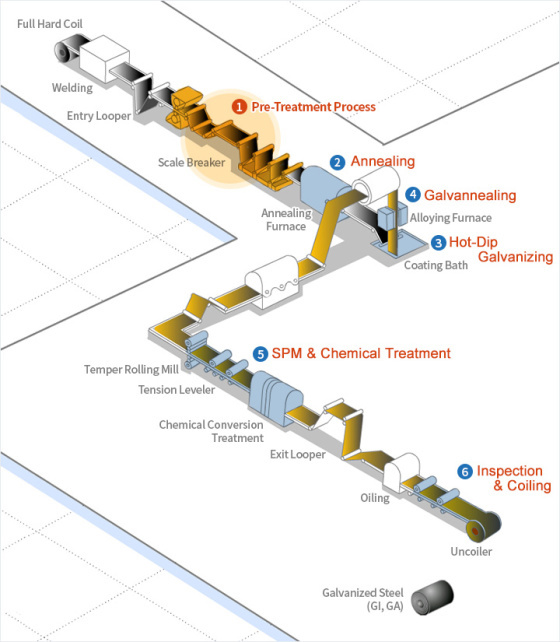
1. Pre-Treatment Process: Some rolling oil and other contaminants remain on the surface of cold rolled steel sheets following processing. These are removed by passing the electrically charged sheet through an alkaline solution which induces an electrochemical reaction.
2. Annealing: The material properties of the pre-treated steel sheet can be altered and improved through recrystallization during the annealing process.
3. Hot-Dip Galvanizing: After passing through the annealing furnace, steel sheets are dipped into a zinc pot where molten Zn is coated onto the surface. The desired coating weight is achieved by removing excess zinc before solidification with high-pressure air from an air knife.
4. Galvannealing: The surface of a steel sheet, after the air knife, can be coated with a zinc compound prior to reheating in an annealing process. Zn atoms diffuse into the Fe to create a Zn-Fe series alloy.
5. SPM & Chemical Treatment: In order to achieve a flat surface and an elegant finish, the steel sheet is processed with a skin pass mill. In order to prevent the white rust, which often forms on the surface of activated zinc, and to improve corrosion resistance, the surface is coated with a Cr-free resin.
6. lnspection & Coiling: In order to achieve a flat surface and an elegant finish, the steel sheet is processed with a skin pass mill. In order to prevent the white rust, which often forms on the surface of activated zinc, and to improve corrosion resistance, the surface is coated with a Cr-free resin.
More Content process") Silicon steel (electrical steel) process
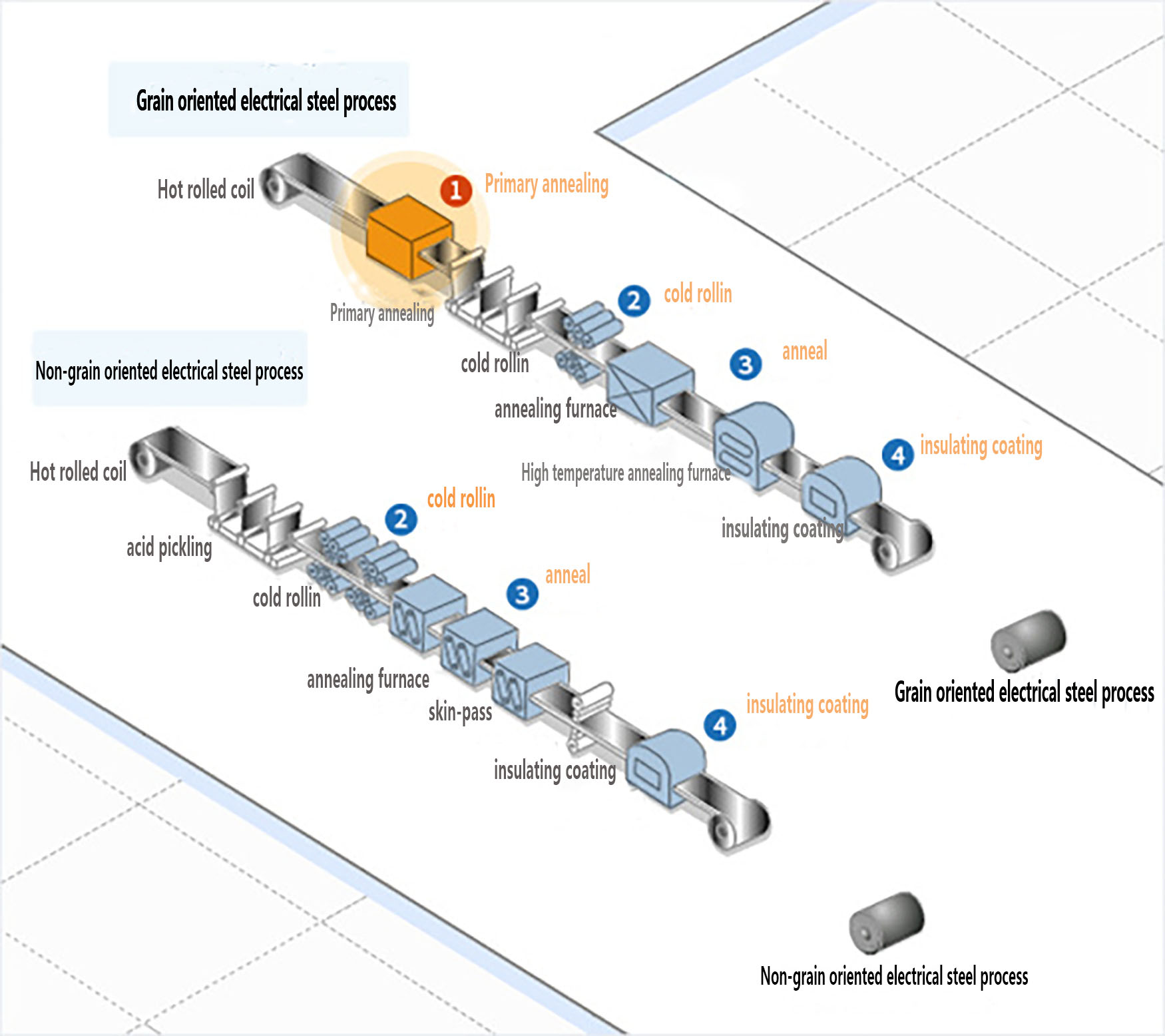
Silicon steel (electrical steel) process1. Preliminary annealing: In the preliminary annealing process, the scale that may form on the hot-rolled steel is removed after delayed passage through the water breaker and hydrochloric acid bath. This initial heat treatment process improves the cold rolling properties and magnetic properties of the steel.
2. Cold rolling: In order to obtain specific thickness and material properties, a reduction ratio of 40-90% is usually used. Automatic control of edging machine and edging machine for uniform thickness and width.
3. Annealing: Annealing is the process of transforming cold-rolled tissue into recrystallized tissue through heat treatment. For grain-oriented electrical steel, there are two different annealing methods: decarburization annealing and high temperature annealing. Decarburizing annealing removes excess carbon from the steel and applies a magnesium oxide coating. High temperature annealing produces a secondary recrystallization structure with superior magnetic properties.
4. Insulation coating: In this process, the insulation coating is applied by the continuous coater roller to minimize eddy current losses proportional to the thickness of the sheet. A series of coating machines are used to apply the insulating coating solution to the top and bottom of the sheet. Grain-oriented electrical steel has two layers of coating, one layer is the bottom coating of dark brown Forsterite (Mg2SiO4) as the main component, and the other layer is the transparent insulating coating containing phosphate. For non-oriented electrical steel, various coating methods with different thicknesses and compositions are used according to the specific requirements of the end use and users. Silicon steel (electrical steel) process
More Content Wire Rod
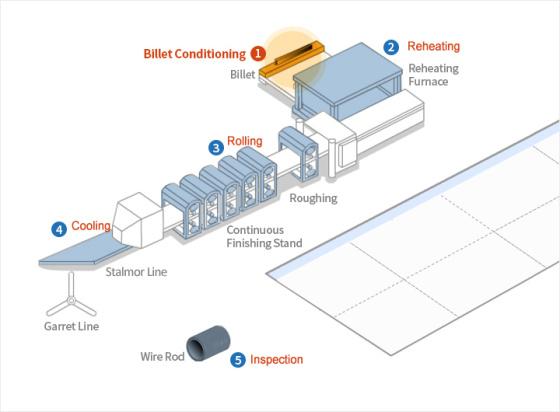
1. Billet Conditioning: This process is intended for checking the surface quality of billet and removing any defects. Shot blast is used to remove any scale from the surface. Magnet particle testing and visual inspection are also used to identify any defects which must be removed using a grinder. Ultrasonic testing and dimension and geometry checking are also applied as part of the internal quality assurance process.
2. Reheating: The temperature within the furnace and the duration of reheating depend on where the product will be used. To avoid decarburization, which can affect the surface quality of the product, a billet is pre-heated sufficiently at a low temperature before being rolled within the reheating furnace. For this purpose, the fuel and air ratio are strictly controlled.
3. Rolling: The temperature, draft and speed of deformation with which the product is rolled are controlled to meet customer requirements for material features. Further measures to ensure the surface quality include the adjustment of roll roughness and gap, detection of any cracks and dimension correction.
4. Cooling: Coiling temperature at the laying head, the air flow and movement speed of the blower on the cooling bed and the cooling speed of the insulation cover are controlled to ensure that the product has the features required for each application. High carbon steel Wire rods are subject to fast cooling to achieve the microstructure required for successful drawing while low carbon steel is subject to slow cooling to ensure that the product provides the softness required for the customer to eliminate an annealing process.
5. Inspection: Samples are taken from the front and rear edges of the product after rolling and cooling for testing to identify any defects in the dimension or surface or material integrity. Packaging and tagging are also inspected according to customer requirements prior to shipping.
More Content Cold Rolled Steel
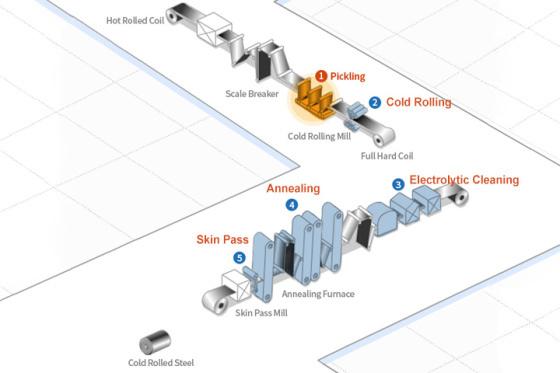
1. Pickling: Hot rolled coils pass through a pickling line, where scale breaker machines and hydrochloric acid solutions are used to remove any surface scale and/or oxide film that which causes surface flaws during the final stage of cold rolled steel processing.
2. Cold Rolling: Pickled coils are cold rolled in tandem mills to a specified thickness, typically 40 to 90%, of original material dimensions. Fully automated shape adjustment is ensured through state of the art process machinery.
3. Electrolytic Cleaning: The purpose of electrolytic cleaning is to remove lubricant oil and contaminants on the cold rolled steel prior to the annealing process.
4. Annealing: This is a highly productive manufacturing method whereby steel products with extra deep drawing qualities and high tensile strength can be produced. Two annealing methods are commonly used: batch annealing and continuous annealing.
5. Skin Pass: This final rolling process is performed in order to remove minor surface defects such as stretch marks and to produce a smooth, lustrous surface. Skin Pass results in a further thickness reduction of about 1%.
More Content



Leave A Message
If you are interested in our products and want to know more details, please leave a message here, we will reply you as soon as we can.